
Dear Ward 5 neighbors,
It’s filling our news cycles, social media feeds, and Council debates: the conversation about “teen takeovers” and how to respond. For months, large gatherings of youth in neighborhoods like Navy Yard, the Wharf, and U Street have led to a variety of responses from neighbors and lawmakers alike. Our screens are filled with images of the National Guard chasing youth across green space in Navy Yard and local police forces struggling to maintain order. Sometimes these gatherings have led to violence, including brawls and even shootings. It’s clear that what is playing out on our streets is not acceptable.
We also know that what is happening isn’t just a local problem. Similar “teen takeovers” are being reported in cities across the country including Baltimore, Memphis, Atlanta, Chicago, and Milwaukee. In DC, we began responding last summer with designated juvenile curfew zones. To be clear, the District already has a citywide curfew that has been in effect for years: 11:00 p.m. – 6:00 a.m., seven days a week. The designated zones, however, allowed the Chief of MPD to declare specific areas as closed off to youth under certain conditions. It is important to remember that when we received the original proposal for these zones, it was very broad: all youth in any designated curfew zone beginning at 6:00 p.m. Through an amendment I introduced, we tightened the parameters—youth gathering in groups of nine (9) or more unless engaged in certain exempted activities and beginning at 8:00 p.m.—so as to not criminalize or punish youth who are simply hanging out after a basketball game or just going to get ice cream with friends.
I supported emergency and temporary implementations of these curfew zones last year as then-MPD Chief Smith shared that it was a needed emergency tool while the executive worked to develop more targeted and durable solutions. The Council held hearings on the extended curfews last fall, and I expressed my skepticism about any permanent application of the law. I am clear that the emergency and temporary versions were band-aids, and not the right long-term fix for what we were seeing among District youth. At that time, there were no arrests for curfew violations or other violations in the zones, we were not seeing regular dustups with police and National Guard, and the zones were used sparingly. By comparison, there are now routine arrests at the zones, we’ve all seen the images of youth being chased by police and National Guardsmen, and the law is now being used as a panacea of sorts to address destructive behavior among youth in the District.
This past week, the Council took up a permanent version of the curfew that won’t take effect until the fall after congressional review, and there was an attempt to advance another emergency application. While the permanent passed the Council on an 8-5 vote and the emergency was delayed because the votes were not there, I could not support either as I believe they are not the durable and effective solution we need. Again, we’ve all seen the images playing out across our screens the past few months, and this is while the designated curfew zones have been in effect! While it may be a tool, it is clear to me that it is an inadequate tool. Not only that, but the Mayor’s FY27 budget slashes youth programming at the Department of Parks and Recreation (DPR), and youth mental health services like ChAMPS are completely zeroed out. Whether it’s the permanent version of the curfew or continued extensions of the emergency version, we cannot continue to use the same insufficient tool while ignoring the larger context and conversations about youth well-being in the District.
I am calling on the Mayor and my Council colleagues to work with me in creating a youth agenda anchored on expanding recreation, employment, mental health, and purposeful accountability. DPR has done a great job in trying to meet this moment, but we need think beyond DPR and imagine how we can activate third spaces, businesses, and other institutions. The number one need I have heard repeatedly from young people is access to jobs and opportunity—and we should be looking beyond government to partner with businesses in extending opportunity and paying youth at least the minimum wage (which is not currently the case in the Marion Barry Summer Youth Employment Program!). We also need to embed mental health resources where youth are—it is clear that trauma is playing out when young people engage in violence. Lastly, I want to reiterate that the behaviors we’re seeing are not acceptable. We can’t turn the other way while youth run amok. Parents must play a greater role in supervising and holding their children accountable. These are the focus areas of a youth agenda I have been actively advocating for.
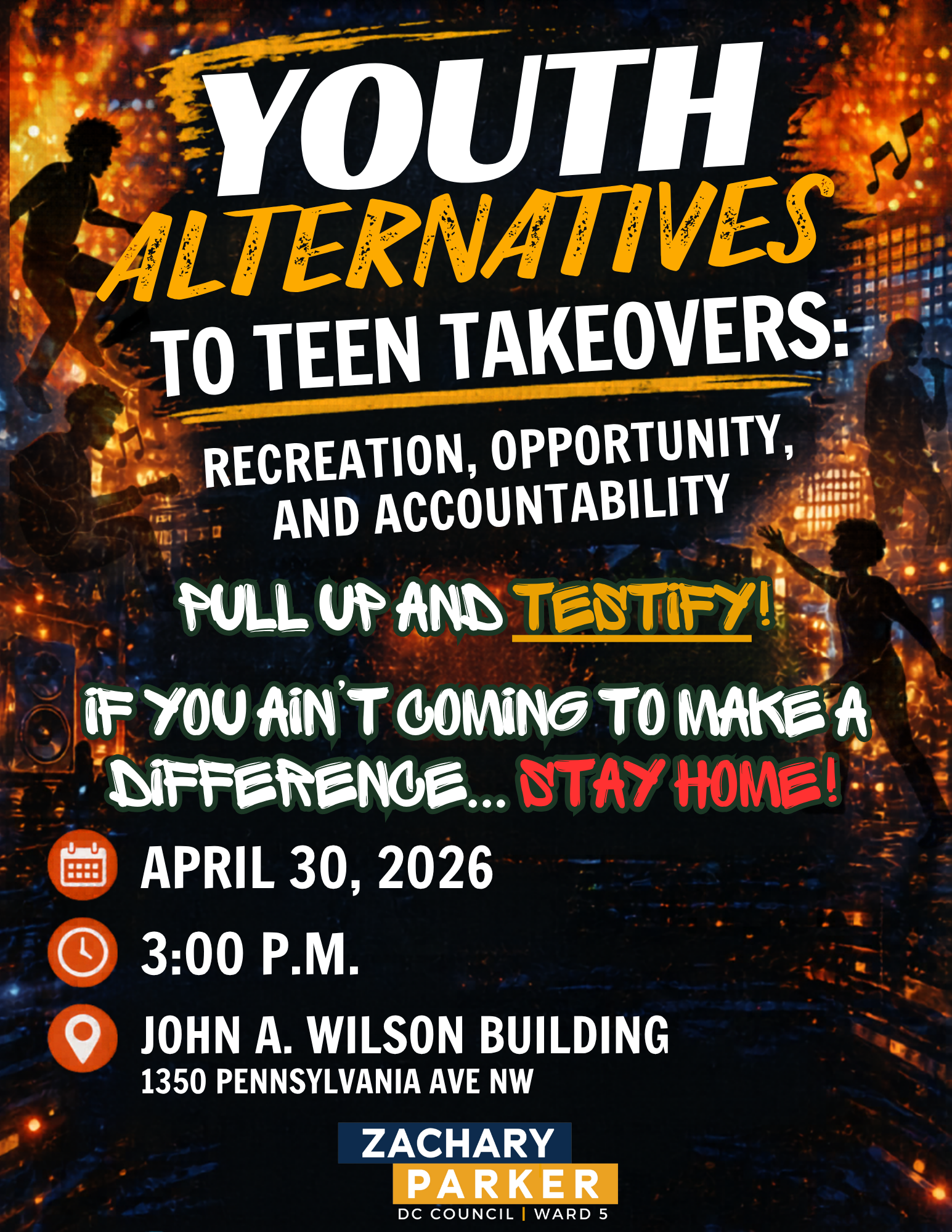
In addition to my work of oversight over the past year—youth engagements and hearings and advancing the C.A.R.E. for Youth Plan—I announced this week that the Committee on Youth Affairs will hold a youth-centered hearing to meaningfully address the need for alternatives to these “teen takeovers.” Please help spread the word and consider testifying or submitting written testimony for our Public Roundtable on Youth Alternatives to Teen Takeovers: Recreation, Opportunity, and Accountability. Originally scheduled for May 8, a request was made for us to move the hearing to April 30 to ensure the conversation happened before the Council’s next vote on the curfew (May 5). We’ll start at 3:00 p.m. and go well into the evening to ensure teens can make it after school to share their perspectives and inform the solutions we develop to better address the troubling behavior we’re seeing.
I reject the vilification of our young people—especially as it is parroted by those in the federal government who do not have our city’s best interests in mind. I hope you will join me in hearing their perspectives and advancing solutions that go beyond reactivity. Sign up here!